
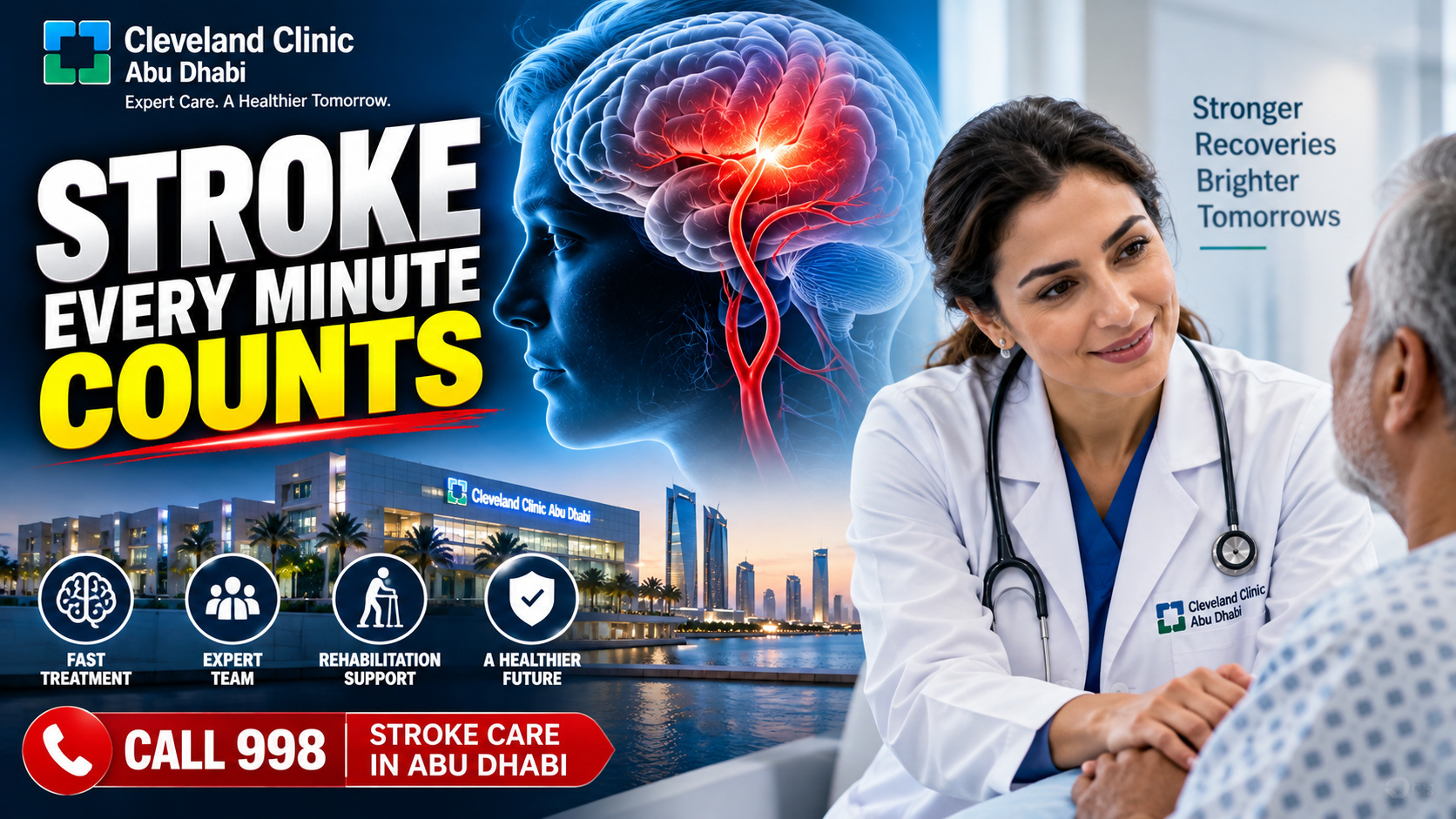
A stroke does not wait for the right doctor to walk into the room. Every minute of blocked blood flow costs brain tissue, yet many hospitals do not have a stroke neurologist on site around the clock. That gap is exactly what telestroke medicine was built to close. Through a live video link, a stroke specialist at a larger center can examine the patient, review the brain scan and guide the emergency team in real time. If you have wondered what telestroke is and how telestroke services work in practice, this guide explains it in plain language, with Abu Dhabi in mind.
Telestroke is a form of telemedicine that connects a stroke specialist to an emergency team in another location through live video and shared brain imaging. The specialist assesses symptoms, reviews the CT scan and recommends treatment such as clot-busting medicine or transfer for thrombectomy, so patients get expert decisions faster, before any transfer takes place.
Telestroke medicine lets stroke specialists treat patients they are not physically beside. The local emergency team, called the originating site, streams the patient and CT images to a stroke center, called the distant site. The specialist runs a stroke scale exam by video, checks the scan, and advises on clot-busting medicine or thrombectomy. Intravenous thrombolysis is generally given within 4.5 hours of symptom onset, while thrombectomy can work for selected patients up to 24 hours, so speed and accurate decisions matter. The main benefits of telestroke are faster treatment, wider access to specialists, fewer unnecessary transfers and a lower risk of long-term disability. Limits exist: it needs stable technology, trained local staff and clear transfer plans. Telestroke does not replace calling an ambulance. If you notice sudden face drooping, arm weakness, speech trouble, vision loss or loss of balance, call emergency services immediately. Abu Dhabi has a designated stroke center.
What Is Telestroke Medicine?
Telestroke medicine, also called virtual stroke care or teleneurology for stroke, is a type of telemedicine in which a stroke specialist evaluates and guides the treatment of a suspected stroke patient at another hospital using live video, shared brain scans and secure communication. The patient stays at the local emergency department while the remote specialist works with the on-site doctors to confirm the diagnosis, choose the treatment and plan any transfer.
How Telestroke Medicine Works
Telestroke rests on a simple idea. The expertise travels, and the patient does not.
Originating site and distant site
Two locations are involved. The originating site is the hospital where the patient arrives, usually an emergency department that may not have a neurologist on call. The distant site is the stroke center where the specialists are based, typically a large multidisciplinary hospital with a dedicated stroke program. Doctors at both ends talk through cameras, tablets, smartphones and secure imaging software. Many health systems describe this as a hub and spoke network, where one strong hub supports several smaller hospitals.
Step by step: what happens during a telestroke consultation
- Stroke is suspected. Paramedics or triage staff spot the warning signs and activate the stroke code.
- The patient goes straight to imaging. A non-contrast CT scan checks for bleeding. CT angiography can show whether a large vessel is blocked.
- The emergency doctor calls the stroke team. A video link opens, often within minutes.
- The specialist examines the patient remotely. With help from the bedside nurse, the neurologist scores symptoms on the NIHSS (National Institutes of Health Stroke Scale), watching the face, arms, speech and eye movements.
- The scans are reviewed live. The specialist also checks blood pressure, blood sugar, current medicines (especially blood thinners) and the last known well time.
- A treatment decision is made together. Options include clot-busting medicine such as alteplase or tenecteplase, transfer for mechanical thrombectomy, or other care if the problem turns out to be a brain bleed or a stroke mimic.
- Care continues. The patient is monitored locally or moved to the stroke center, and the specialist stays reachable.
Summary box: Telestroke connects an emergency team (originating site) with a stroke specialist (distant site) by live video and shared scans. The specialist examines, reviews imaging and recommends treatment within the critical early window.
Why Every Minute Counts in Stroke Care
A stroke happens when blood flow to part of the brain stops. An ischemic stroke, the most common type, is caused by a clot blocking a vessel. A hemorrhagic stroke is caused by bleeding. The two need opposite treatments, which is why a scan and a specialist opinion come before any medicine.
Timing shapes what is possible:
- Intravenous thrombolysis (clot-busting medicine) is generally given within 4.5 hours of symptom onset.
- Mechanical thrombectomy, where a device removes the clot, has been shown to help selected patients with a large vessel occlusion up to 24 hours after onset, when imaging shows brain tissue that can still be saved.
- An often quoted estimate suggests the brain can lose around 1.9 million neurons every minute during a large vessel stroke. The exact number matters less than the point. Delay costs speech, movement and independence.
The problem is that not every hospital has a stroke neurologist available at 3 a.m. Telestroke fills that gap. It shortens the wait for an expert opinion, and the door-to-needle time (the time from arrival to clot-busting treatment) can improve as a result.
Telestroke Services: What They Include
Telestroke services vary between health systems, but most cover the following.
Remote neurological assessment
A stroke specialist examines the patient by video and scores stroke severity, guiding the bedside team through each test.
Imaging interpretation
The neurologist reads CT, CT angiography and sometimes CT perfusion or MRI images in real time to separate ischemic stroke from bleeding and to look for a large vessel blockage.
Thrombolysis guidance
The specialist confirms eligibility, checks for reasons the medicine could be unsafe, and supports dosing and monitoring after treatment.
Thrombectomy triage and transfer coordination
If a large vessel occlusion is found, the specialist arranges transfer to a center with a neurointerventional team, often while the first treatment is already running.
Ongoing stroke unit advice
Telestroke can also support blood pressure targets, swallowing checks, secondary prevention and rehabilitation planning after the emergency phase.
In-hospital stroke support
Strokes sometimes happen in patients already admitted for something else. Telestroke gives those wards fast access to an expert too.
Summary box: Telestroke services include remote exams, live imaging review, thrombolysis guidance, thrombectomy triage, transfer planning and ongoing stroke unit advice.
Benefits of Telestroke Medicine
The benefits of telestroke come down to speed, access and better decisions.
- Faster treatment. Expert evaluation starts as soon as the video link opens, so vital treatment can begin sooner.
- Lower risk of stroke-related disability. Earlier treatment generally means less brain damage and a better chance of recovery.
- Wider access to stroke specialists. Patients in more locations can reach expertise that once existed only in large centers.
- Fewer unnecessary transfers. Some patients can be assessed and treated locally, which saves time, cost and stress for families.
- Better decisions than a phone call. In one randomized trial comparing phone-only consults with video consults for acute stroke, correct treatment decisions were made more often with video (98 percent versus 82 percent).
Pros and cons at a glance
| Advantages | Disadvantages |
|---|---|
| Expert opinion within minutes | Needs reliable video and imaging links |
| Supports clot-busting treatment at local hospitals | Cannot replace hands-on examination or procedures |
| Reduces avoidable transfers | Some patients still need transfer |
| Strengthens stroke networks and training | Requires trained local staff and clear protocols |
Telestroke vs Other Ways of Getting Stroke Expertise
| Feature | Telestroke | On-site stroke team only | Transfer without consultation |
|---|---|---|---|
| Specialist availability | Around the clock through a network | Only where a team is staffed | Depends on receiving hospital |
| Time to expert opinion | Minutes | Immediate, if the team is present | Delayed until arrival |
| Imaging review | Live, shared | Live, in person | After transfer |
| Need for transfer | Only when required | Only when required | Always |
| Best for | Hospitals without a full-time stroke team | Comprehensive stroke centers | Rarely the best option |
| Main limit | Technology and training | Cost and staffing | Lost treatment time |
Summary box: Telestroke delivers faster expert decisions, wider access and fewer avoidable transfers. Its main trade-offs are reliance on technology and the fact that it cannot replace hands-on care.
Telestroke Medicine in Abu Dhabi
Abu Dhabi has invested heavily in emergency and neurological care, and stroke is treated as a time-critical priority. Cleveland Clinic Abu Dhabi, which the Department of Health has designated as the official Stroke Center for Abu Dhabi, runs a comprehensive stroke program. It covers rapid emergency treatment, evaluation, stabilization and post-stroke rehabilitation, supported by its Neurological Institute.
For residents and visitors, three practical points stand out:
- Do not drive yourself or a family member if an ambulance can reach you. Paramedics can assess symptoms and alert the hospital before arrival.
- Call 998 for an ambulance, or 999. Give the address, say “possible stroke” and state when symptoms began.
- Ask about stroke pathways in advance. If you or a relative has high blood pressure, atrial fibrillation or a previous stroke, ask your doctor which hospital nearby has a stroke pathway and specialist access.
When Is Telestroke Used?
| Situation | Is telestroke useful? | Why |
|---|---|---|
| Symptoms began within 4.5 hours at a hospital without a stroke neurologist | Yes | Fast decision on clot-busting medicine |
| Suspected large vessel occlusion | Yes | Helps decide on thrombectomy transfer |
| Symptoms noticed after waking up | Yes | Imaging-guided decisions can still open treatment options |
| Symptoms that disappeared quickly (possible TIA) | Yes | Helps decide on admission and work-up |
| Patient already at a comprehensive stroke center with on-site neurologists | Usually not needed | The team is already in the room |
| Suspected brain bleed needing surgery | Helpful for triage | Transfer to neurosurgery is likely |
What Most People Misunderstand About Telestroke
A few ideas come up again and again when people talk about virtual stroke care.
“It is just a phone call to a doctor.” It is not. Telestroke combines live video, a structured neurological exam and direct review of brain images.
“Remote means lower quality.” The specialist makes recommendations with the local team, not instead of them. The local doctors and nurses stay hands-on throughout.
“If telestroke is available, I will not be transferred.” Sometimes you will. Thrombectomy and neurosurgery still need specialized centers. Telestroke just makes sure the transfer is timely and necessary.
“I can request telestroke from home.” Telestroke is a hospital-to-hospital service. In an emergency, the route is the ambulance and the emergency department.
“The symptoms went away, so I am fine.” A transient ischemic attack (TIA) is a warning stroke. It still needs urgent assessment.
Summary box: Telestroke is a structured, video-based specialist service between hospitals. It supports local teams, does not remove every transfer, and is never a substitute for calling an ambulance.
Common Mistakes During a Suspected Stroke
- Waiting to see if it passes. Symptoms that ease can return worse.
- Driving to a clinic instead of an emergency department. Clinics rarely have CT scanners or stroke teams.
- Not noting the last known well time. This is the first thing the stroke team asks for.
- Giving food, water or aspirin. Swallowing may be impaired, and aspirin is unsafe if the stroke is a bleed.
- Forgetting the medication list. Blood thinners change treatment decisions completely.
Expert Tips for Patients and Families
- Learn the signs using B.E. F.A.S.T.: Balance, Eyes, Face, Arms, Speech, Time.
- Write the last known well time on your phone the moment you notice symptoms.
- Keep an updated medicine list and medical history in your phone or wallet, especially for anyone with hypertension, diabetes or atrial fibrillation.
- Share the plan with relatives so more than one person knows what to do.
- After a stroke, ask about rehabilitation and secondary prevention early. Recovery starts in hospital, not weeks later.
Limits of Telestroke You Should Know
Telestroke is powerful, but it is not magic. The connection must be stable, and the local team needs regular training so the remote exam is done well. Imaging has to be shared quickly and securely. Some diagnoses are harder through a screen, and stroke mimics such as seizures or migraine can be confusing. Finally, telestroke works best when a clear transfer agreement already exists with a comprehensive stroke center. The technology helps, but the system around it decides the outcome.
People Also Ask
What is telestroke?
Telestroke is virtual stroke care. A stroke specialist at one hospital assesses and advises on treatment for a patient at another hospital using live video and shared brain scans.
How does telestroke work?
The emergency team at the local hospital scans the patient and connects to a stroke specialist by video. The specialist examines the patient remotely, reviews the images and recommends treatment or transfer.
What are the benefits of telestroke?
Faster treatment, wider access to stroke specialists, fewer unnecessary transfers and a lower risk of long-term disability. It also supports local teams with expert guidance.
How long do you have to treat a stroke?
Clot-busting medicine is generally given within 4.5 hours of symptom onset. Thrombectomy may help selected patients with a large vessel blockage for up to 24 hours. Earlier is always better.
Is telestroke the same as telemedicine?
Telestroke is one type of telemedicine, built specifically for emergency stroke care. General telemedicine covers many conditions, while telestroke focuses on rapid assessment and treatment decisions.
FAQ
Is telestroke as reliable as seeing a stroke neurologist in person?
For the decisions that matter most in the first hours, telestroke performs well. The specialist sees the patient live, scores the neurological exam and views the same CT and CT angiography images they would see in their own hospital. In one randomized trial comparing phone-only consults with video consults, correct treatment decisions were made more often with video (98 percent versus 82 percent). A German telestroke network study that included patients treated between 3 and 4.5 hours found similar discharge outcomes and in-hospital mortality between network hospitals and the main stroke center. What telestroke cannot do is replace hands-on care. A neurologist cannot feel muscle tone or perform a procedure through a screen, so the local team stays essential. Think of it as the specialist’s eyes and judgment arriving quickly, with the local team’s hands doing the work.
Will I still be transferred to another hospital?
Sometimes, yes. Telestroke reduces unnecessary transfers, but it does not remove necessary ones. If the scan shows a large vessel blockage, mechanical thrombectomy may be needed, and that requires a neurointerventional team and specialized equipment. The same applies to brain bleeds that need neurosurgery or patients who need intensive monitoring. The difference is timing and confidence. Because the specialist has already reviewed the patient, clot-busting medicine can often be started at the local hospital while the transfer is arranged, and the receiving team is ready when the patient arrives. In other cases, such as a mild stroke or a TIA, the patient can be treated and monitored locally with specialist guidance. Your emergency doctor will explain which path applies to you.
Who provides telestroke services, and how do I know if a hospital offers them?
Telestroke is usually run by a stroke center that partners with smaller hospitals, forming a hub and spoke network. The hub supplies neurologists on a rota. The local hospital supplies the patient, the scan and the bedside team. Not every hospital belongs to a network, and the setup differs between health systems. The practical way to check is to ask your hospital or insurer whether the emergency department has a stroke pathway and access to a stroke neurologist, in person or by video. In Abu Dhabi, hospitals are regulated by the Department of Health, and Cleveland Clinic Abu Dhabi holds the designation of official Stroke Center for the emirate. In an actual emergency, do not spend time researching. Call an ambulance, and the paramedics will take the patient to a suitable emergency department.
What should family members do in the first minutes of a suspected stroke?
Keep it simple and act fast. Check for B.E. F.A.S.T. signs, and if you see any, call an ambulance immediately (998 or 999 in the UAE). Note the exact time symptoms began, or when the person was last seen normal. The stroke team asks for this first because it decides which treatments are possible. Do not give food, drink or aspirin unless a medical professional tells you to. Do not drive the patient yourself if an ambulance can reach you, because paramedics can alert the hospital in advance. Gather the medicine list, especially any blood thinners, and a short medical history. Stay with the person, keep them calm and lying comfortably, and tell the ambulance crew everything you noticed.
Stroke care is a race against the clock, and telestroke medicine helps hospitals run that race with an expert beside them, even when the expert is miles away. By linking emergency teams to stroke specialists through live video and shared imaging, telestroke services bring faster decisions, wider access and fewer unnecessary transfers. They do not replace ambulances, emergency departments or specialist centers. They make the whole system work better. Learn the warning signs, note the time, and call for help at once. The benefits of telestroke begin only when the patient reaches care in time.
Key Takeaways
- Telestroke is virtual stroke care that connects an emergency team with a stroke specialist through live video and shared scans.
- The originating site treats the patient, and the distant site provides the specialist.
- Clot-busting medicine is generally given within 4.5 hours, and thrombectomy can help selected patients up to 24 hours.
- The main benefits are faster treatment, better access, fewer unnecessary transfers and a lower risk of disability.
- Telestroke has limits: it needs reliable technology, trained staff and clear transfer plans.
- Always call an ambulance first. Telestroke starts after the patient reaches the hospital.
يقدّم مستشفى كليفلاند كلينك أبوظبي رعاية متكاملة لمرضى السكتة الدماغية، بدءاً من التقييم السريع في قسم الطوارئ والتشخيص بالأشعة المتقدمة، وصولاً إلى العلاج الدقيق وبرامج إعادة التأهيل بعد السكتة، وذلك عبر معهد الأعصاب وفريق من الأطباء والممرضين المدرّبين وفق أعلى المعايير الدولية. والمستشفى هو المركز المعتمد من دائرة الصحة – أبوظبي كمركز رسمي للسكتة الدماغية في الإمارة، ما يعني أن المريض يجد الخبرة والتقنيات المتقدمة في مكان واحد وفي وقت تُحسب فيه كل دقيقة. وإذا لاحظتم أي علامة من علامات السكتة الدماغية فاتصلوا بالإسعاف فوراً، وللاستفسار أو حجز موعد يسعد فريقنا بخدمتكم. لمزيد من المعلومات يمكنكم زيارة موقعنا الإلكتروني www.clevelandclinicabudhabi.ae أو الاتصال على الرقم 800 8 2223، ويقع المستشفى في 59 شارع حمودة بن علي الظاهري، جزيرة الماريه، أبوظبي، الإمارات العربية المتحدة.